
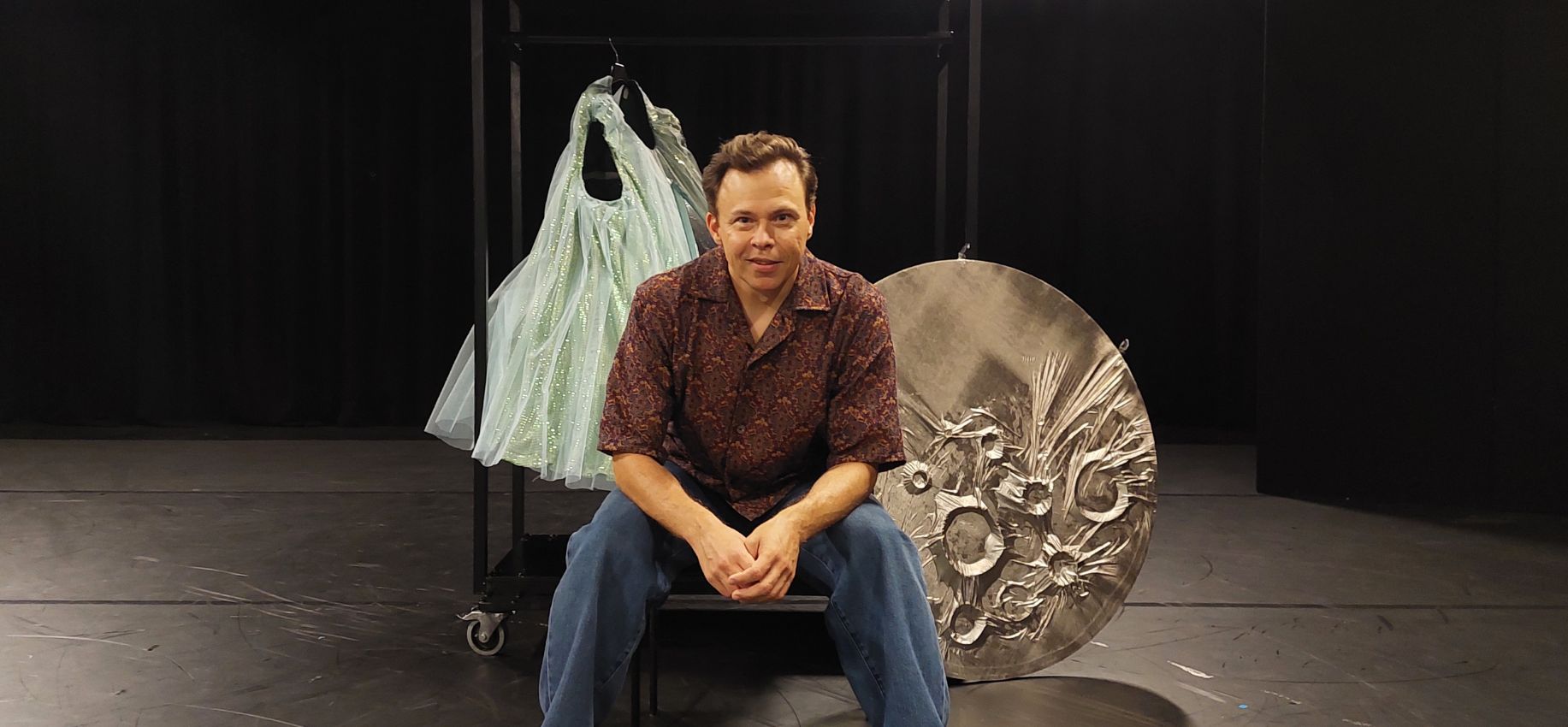
The Pond, a family-friendly performance that combines dance and clowning, premieres on Hurjaruuth’s stage on 17 September 2026. How did the performance come about, and what is it about? Director and choreographer Carl Knif is here to answer our questions.
How would you introduce yourself? What kind of background do you have, and what are your working methods?
I originally trained as a dancer, and dance remains very important to me. Everything I create stems from my own physicality and sense of movement. I have been creating my own choreographies for around twenty years now. In 2012, I founded my own group, Carl Knif Company.
It’s been important to me to find different, even unusual, platforms on which to work as a choreographer. I have worked in theatres with actors and created physical theatre productions, and I have collaborated with singers. Accessibility in the arts is important to me. I have worked with performers with intellectual and learning disabilities at DuvTeatern in Helsinki and at Moomsteatern in Malmö.
Where did the idea for The Pond come from?
It was Hurjaruuth’s Director General Jyrki Karttunen who first suggested a collaboration. Clown Gabriela Muñoz already had an idea for a chicken character and had come up with a rough story around it.
I had never worked with a clown before. The art of clowning was something new and fascinating to me. Gaby and I met, and our communication felt natural and inspiring right from the start. We began working on the script together and created new characters for the story. Gradually, the theme crystallised around self-discovery and self-acceptance.
The ballet Swan Lake and the fairy tale The Ugly Duckling served as catalysts and sources of inspiration for the work, and references to both can be seen in the finished performance. However, The Pond is its own story.
What kind of movement will we see in The Pond?
Facial expressions and gestures, which draw on clowning techniques, play a major part in The Pond’s movement language. We use a great deal of them because The Pond is a non-verbal performance. In addition, the performance features traditional contemporary dance, interspersed with references to classical ballet. Alongside elements of classicism and romanticism, the movement and visual elements incorporate geometry and angularity, as well as a deliberate two-dimensionality. These elements lend the piece a fairy-tale quality.
I have always been fascinated by modernism, early 20th-century art, the first experiments at that time combining visual and performing arts, and the Bauhaus aesthetic. Traces of all these can be seen in The Pond.
The costumes and the scenography are unique and especially visual in The Pond. How did they come about?
This is the first time I’m collaborating with costume designer Valentina Munõz. Valentina and I hit it off straight away, and our styles complement each other perfectly.
The visual aspect of my work is particularly important to me. In my productions, the costume design, set design and lighting design all stem from the same initial concept and complement one another. We set about developing all these elements together with the production team right from the very start of the process.
Whilst working with Valentina, the idea of clear forms and costumes that are so large they’re almost like sets began to take shape. We wanted the costumes to give rhythm to the space and to enhance movement and expression.
Dance and movement always place high demands on costumes. In addition, clowning requires costumes to have specific technical features. Fortunately, Valentina knows this field well, having worked with her sister Gaby for many years.
There are many characters in The Pond, and they all have costumes that are very striking and have required original technical solutions. When designing the costumes, we had to take into account that there are many quick costume changes in the performance, as there are so many characters and only four performers. Costume design and production have been a major and demanding aspect of the project, but I believe we have succeeded extremely well in this regard.
Have you created other works aimed at children or families? Why did you want to make one now?
I have created works aimed at families and children before during my career. Among other things, I created a stage adaptation of Alice in Wonderland for Hurjaruuth in 2019 and directed the children’s opera Var är smörgåsen? at the Royal Swedish Opera in Stockholm in 2023.
When creating performances aimed at children and families, I’m drawn to the freedom of imagination, the way in which imagination can be used in a completely different way. This gives me a great sense of freedom in terms of visuals and expression. I’m also fascinated by finding a way to tell a story in a way that’s easy to understand, and by how I can refine the narrative to make it even clearer.
When creating works aimed specifically at children, I feel that I’m even more in the dark than I am when working on a performance intended for adults. It’s difficult to know in advance how children will react to the performance.
As the theme began to take shape, I realised just how important it is to tell this particular story to a young audience. The performance tackles the rather sensitive subjects of self-acceptance and being different, but does so with warmth and gentleness. The combination of clowning and dance brings joy and humour to the piece.
What have you found the most interesting in creating this performance?
The most interesting aspect of the creative process has been getting to know clowning and Gaby. We both work in the performing arts, but from quite different perspectives. It’s been fascinating to observe Gaby at work, to draw inspiration from it and learn new things, and to see the kinds of things she works on.
Although we are telling a story, working in the field of dance always begins with movement, form or rhythm – some abstract element. In clowning, on the other hand, we start with the character and their reactions, with what the character is feeling.
What message do you want to convey to the audience through The Pond?
Through The Pond, I’d like to convey the message that it’s normal to feel like an outsider, and that it’s also okay to dream of being different or more like someone else. Yet one of the wonderful things about life is that we’re all different. I hope this work will encourage us to be ourselves.
The Pond on Hurjaruuth’s stage on 17 September to 17 October 2026. Age recommendation 4+.